


For today’s adult learners, the path to meaningful employment is rarely straightforward. Job seekers and career changers often navigate this journey with urgency, uncertainty, and limited guidance. From the moment someone realizes their current role no longer fits— due to life changes, financial pressure, or the search for purpose — to the moment they step into a fulfilling career, the process demands more than job listings and generic advice. It requires personalized support, emotional validation, and tools that can adapt to shifting goals and life contexts. Further, it requires the development of professional capital, a term previously coined for the teaching profession, which describes the systematic development and integration of three types of capital: human, social, and decisional capital. We wondered how we could apply or modify this framework for broader contexts.
To better understand how to support individuals in educational pathways that lead to successful careers, our most recent research and development work has focused on exploring what professional capital means for the broader population and how technology can help fill some of the gaps in the existing college-to-career ecosystem.
This investigation is centered on a core problem statement: adult learners face fragmented and inequitable career guidance that doesn't dynamically adapt to their needs or address their specific capital gaps.
Our proposed solution to this challenge is as follows: to create AI-powered, personalized support that adapts to individual learners and provides targeted interventions to build professional capital throughout their career journey. To accomplish this solution, our theory of change follows that if learners receive personalized, AI-guided support to build Professional Capital in four core domains, they will be better equipped to navigate transitions with confidence and clarity, and ultimately access more equitable and meaningful employment opportunities. These four domains include: Knowledge/Skills/Credentials, Career Navigation, Dispositional, and Social/Network Capital.
Core Assumptions
- Access to technology and AI tools can democratize career guidance
- The four-capital framework accurately captures what drives career success
- Personalized and timely interventions are more effective than generic advice
- Addressing both practical and emotional barriers is essential for sustained progress
This theory emphasizes the focus on equity, adaptation, and the comprehensive support needed throughout the entire career journey rather than just job placement.
Framework: Building and Maintaining Professional Capital Across Four Core Domains
When thoughtfully designed and human-centered, Artificial Intelligence (AI) can serve as a powerful and responsive support system. It can demystify pathways, simulate mentorship, suggest next steps, replicate puzzles and problems, and anticipate challenges. AI can meet learners where they are—offering career clarity, building confidence, and opening doors that have historically been closed to many.
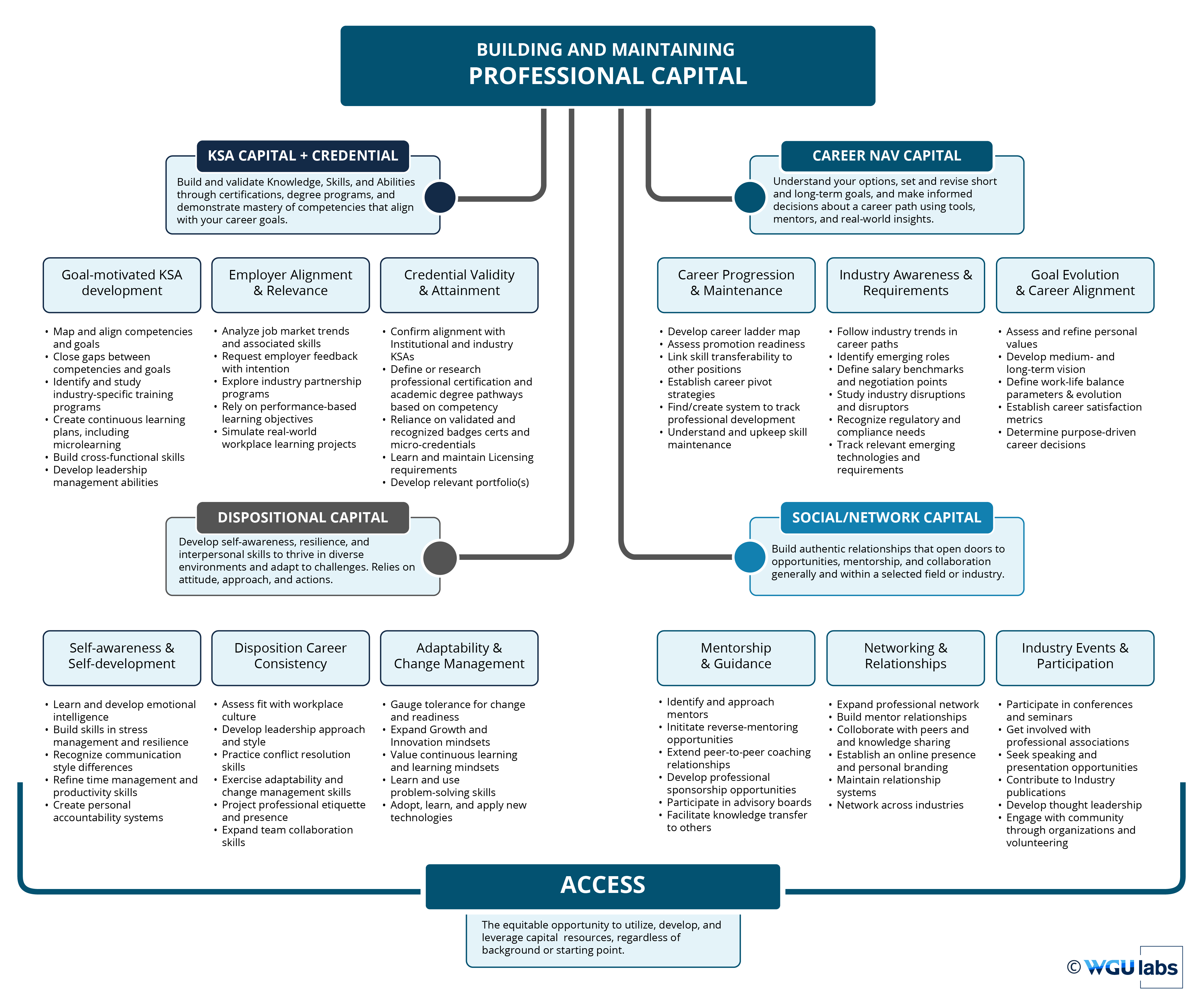
To guide the creation of our technology-based student journey support system, we created a framework for Building and Maintaining Professional Capital, which outlines four essential capital domains that drive upward mobility:
- Knowledge, Skills, and Abilities Capital + Credentials: Build and validate Knowledge, Skills, and Abilities through certifications, degree programs, and demonstrated competencies that align with career goals.
- Career Navigation Capital: Understand your options, set and revise short and long-term goals, and make informed decisions about a career path using tools, mentors, and real-world insights.
- Dispositional Capital: Develop self-awareness, resilience, and interpersonal skills to thrive in diverse environments and adapt to challenges. Relies on attitude, approach, and actions.
- Social/Network Capital: Build authentic relationships that open doors to opportunities, mentorship, and collaboration generally and within a selected field or industry.
These forms of capital, when cultivated together, equip learners not only to secure employment but to advance and thrive over time. Importantly, Access is foundational to this framework, not as a capital itself, but as the condition that must be present across all stages and systems to ensure that opportunities are truly equitable.
How We’re Deploying the Framework
By leveraging this new, research-informed framework, our team has developed a preliminary protocol to guide students through their career attainment journey. According to our theory of action, students will arrive (say, at a program or while exploring an institute's website) with an unknown status regarding their goals or career capital. In their first interactions with an AI agent, it needs to delve into questions about their goal and, once the goal is confirmed, the AI agent can lead the student to identify the current gaps in the four capital quadrants for that goal (social networks, skills, knowledge, credentials & certifications).
The agent runs through a process that adapts to the learner by continuing to monitor where the student is in relation to the goal:
- Define the Goal: AI tools begin by helping learners explore and refine their career goals, starting with broad discovery or using structured frameworks like SMART.
- Identify Barriers: Once the goal is clear, learners surface potential roadblocks. AI provides connections to resources, coaching prompts, and real-life examples of how others have navigated similar challenges.
- Align Learning to Gaps: With goals and barriers known, the tool helps identify where learners need to grow, whether that’s in skills, networks, or confidence, and aligns coursework and experiences accordingly.
- Prepare for Applications: The AI assists with resume building, interview prep, and showcasing achievements, bridging the gap between learning and employment.
- Simulate Interviews and Build Confidence: Through mock interviews and behavioral feedback, learners can develop self-awareness and present their full story with confidence.
- Role Attainment and Beyond: After the learner has obtained their position, the agent can provide additional onboarding resources and guidance. Beyond the initial role, the agent can continue to provide tailored advice for career advancement and progression.
The agent is flexible enough to adjust to changes in the learner’s goal and activities. We are in the initial stages of testing this agent and model within our larger student support system, which is already being piloted (see results from our initial student support agent here).