


Introduction
FY25 marked a turning point for WGU Labs as we accelerated from research and planning into development, prototyping, and testing of AI-powered solutions designed to help solve the Wicked Problems we believe must be addressed to transform postsecondary education. To summarize, these include:
- Preparation and access to post-secondary education: Many potential students face unnecessary barriers to higher education due to outdated entry pathways and a lack of transparency regarding costs and financial aid, which limits access and opportunity.
- The learning experience: The needs of today’s diverse learners are not being met by the curricula, support systems, and instruction currently deployed, despite existing science of learning and social psychology that could be leveraged to improve the learning experience.
- Leap from learning to opportunity: The transition from education to employment remains unclear and inefficient, with higher education poorly aligned to support the continuous learning and career evolution that today’s workforce demands.
Table of Contents
- WGU Labs by the Numbers
- Product and Tool Development
- Research and Insight Generation
- Wicked Problem 1: Preparation and access to post-secondary education
- Wicked Problem 2: The learning experience
- Wicked Problem 3: Leap from learning to opportunity
- Conclusion
Product and Tool Development
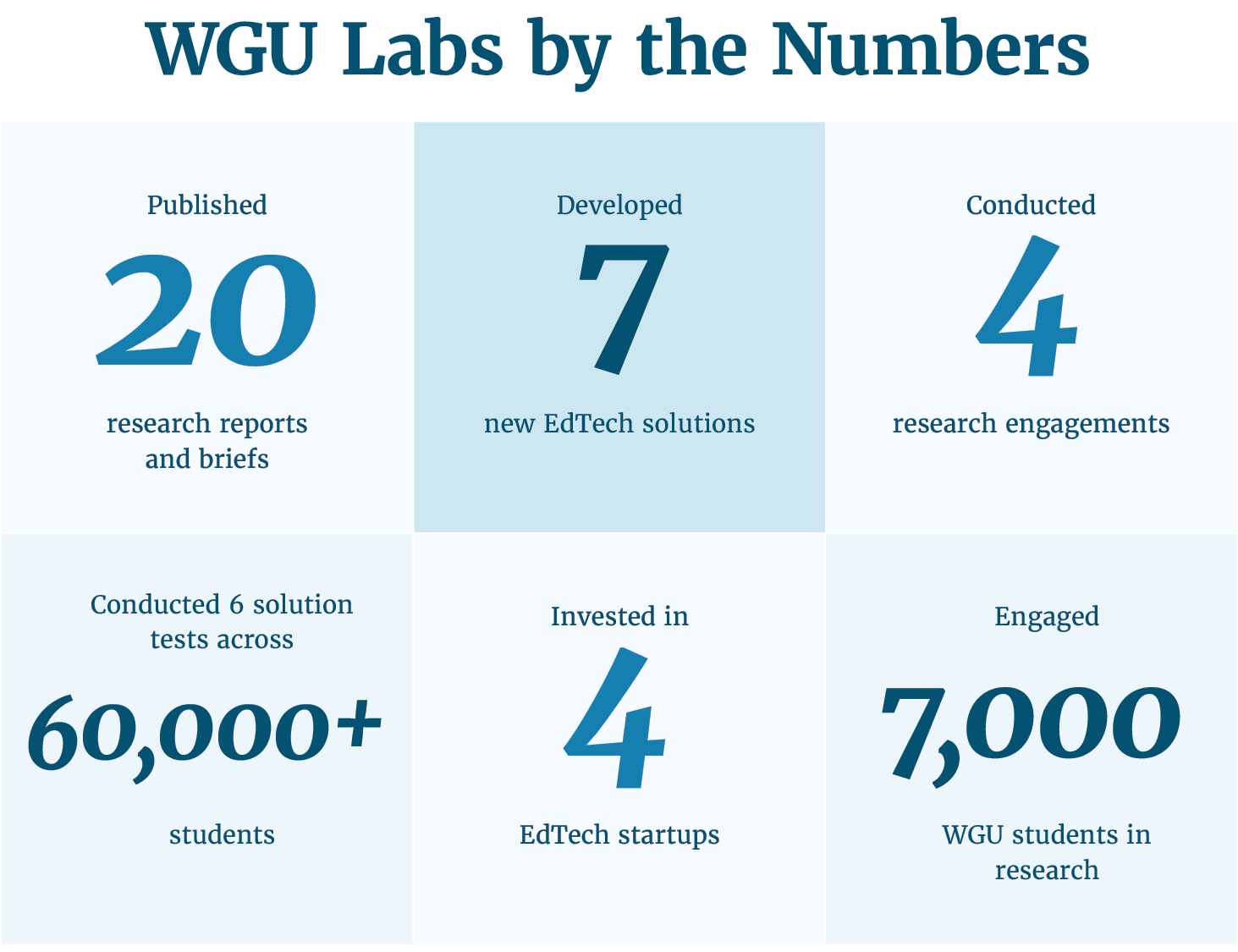
This year, WGU Labs fully engaged in the development of AI tools, frameworks, and models across various domains and focus areas, many of which have been prototyped and deployed for user testing within the WGU system:
- Lazuli, an AI-powered learning design platform that enables rapid, standards-aligned, engaging course creation; co-developed with the Learning Design Alliance.
- An agentic student support platform that offers personalized, holistic guidance informed by data and predictive analytics.
- Nursing student assessments, including dynamic formative tasks and simulated patient interactions.
- Pre-service teacher simulations that provide hands-on practice scenarios, actionable feedback, role-play conversations, and opportunities to differentiate instruction.
-
Research and Insight Generation
In addition to tool deployment and testing, we continued to engage in research that uncovered valuable insights about target student populations (including Rising Talent), the psychology of student success, and employer attitudes toward postsecondary opportunities.
- Launched the WGU Student Insights Council:
- Created a standing panel of over 8,000 current students to power rapid feedback cycles for product development and engagement research.
- Conducted over 15 studies, engaging 7,000 students in surveys, interviews, and user testing.
- Obtained substantive feedback on three of our emerging solutions.
- Advanced our three research pillars:
- Rising Talent: Surveyed non-completers to identify reengagement opportunities and better understand their characteristics and barriers.
- Psychology of Student Success: Completed an RCT of a belonging/resilience intervention and began qualitative research into AI-powered student support.
- Value of Postsecondary Learning: Piloted orientation tools, peer mentoring, and AI-led instruction across multiple programs.
Together, these efforts reflect our shift from exploration to execution within the AI-supported learning experience. The year ahead will focus on rigorous testing, scaling promising models, and continuing to ensure that new AI capabilities are grounded in learning science, designed for diverse learners, and positioned to create real, equitable value in higher education.
As we prepare for 2026, we wanted to revisit last year’s predictions to assess whether the rapidly evolving world of education and technology has progressed as we envisioned. In the following, we review our previous predictions, reflect on progress against the Wicked Problems, and provide revised forecasts for the new year.
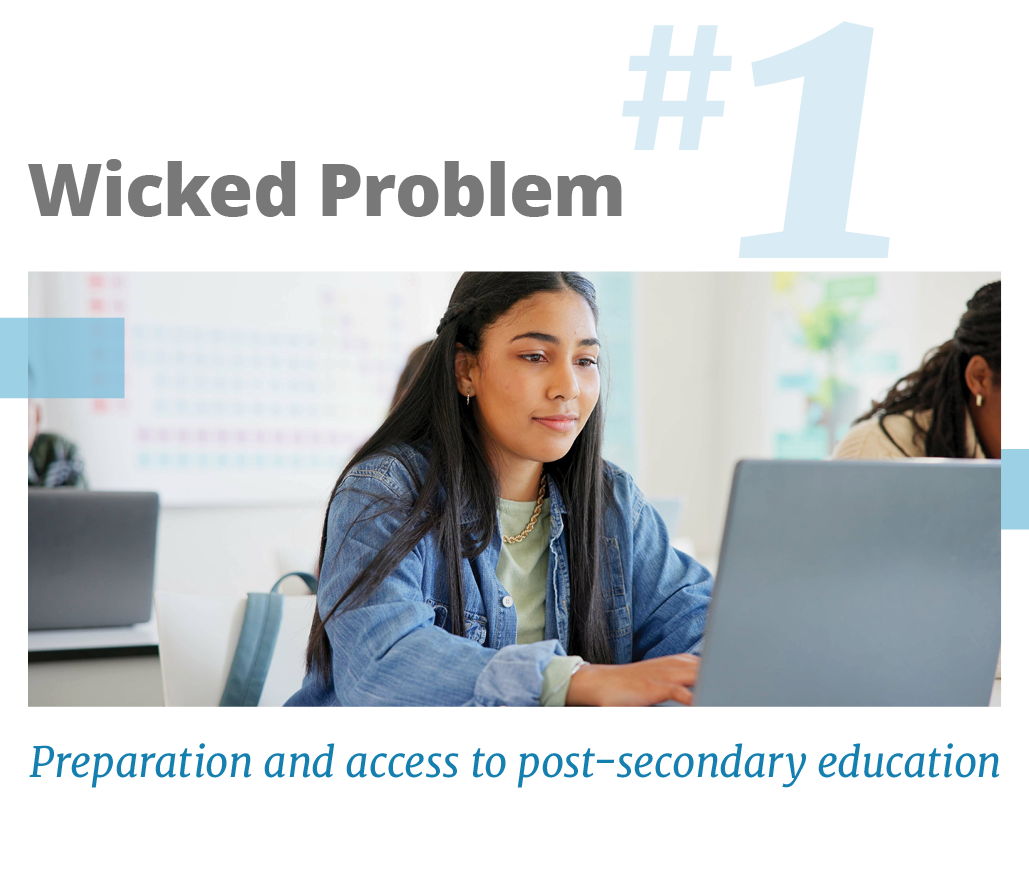
In this section, we explore last year’s predictions and our progress toward solving some of the access and preparation issues that persist in postsecondary education. As a refresher, within this broader topic, our work focuses on the following specific challenges:
- Routes and entry points to higher education unnecessarily limit access for individuals who do not match the historic student profile.
- Lack of transparency around cost, debt, and financial instruments adds structural impediments to access and burdens on student populations that can inhibit their potential as individuals.

Last Year’s Prediction:
“2025 will see the rise of small, specialized language models that will revolutionize higher education by enabling highly tailored applications for niche academic and administrative tasks. Unlike general-purpose large language models, these compact systems will leverage refined, domain-specific datasets to deliver precise, context-aware insights, driving innovations in personalized learning, adaptive assessment, and faculty research support. Their streamlined architecture will reduce computational costs and privacy concerns, making them an indispensable tool for digital-first universities seeking to optimize their operations and enhance student outcomes.” – Jason Levin, Executive Director, WGU Labs

What we know now
This prediction proved accurate, as 2025 did see a proliferation of highly tailored use cases for postsecondary institutions to utilize AI in support of efficiency, quality, and speed, many of which have been built through specialized language models trained on postsecondary knowledge and datasets.
Current reporting suggests that institutions are primarily using AI as point solutions to enhance existing functionality. More specifically, according to a recent Inside Higher Education survey, university provosts report using AI primarily for virtual chat assistants (50%), followed by research and data analysis (31%), learning management systems (28%), administrative tasks (24%), and grading and assessment (17%).
The deployment of these efforts remains uneven. According to a recent EdTech Magazine piece, “You have institutions with these big chatbots trained on all their institutional information,” says Jenay Robert, senior researcher at EDUCAUSE. “And then you have others who are kind of tinkering with the idea and maybe building smaller applications. It’s all over the place.”
In developing AI-based tools, we’ve explored both multi-agent and single-agent systems, as well as the impact of access to robust data on personalization. One of our current pilots, Lazuli — an AI-powered course authoring platform co-developed with the Learning Design Alliance (LDA) — is showing promising results. Designed to embed best practices from learning science into curriculum development, Lazuli is proving effective in generating engaging, practice-enabling learning experiences for students relative to former versions of courses developed with traditional methods.
Our related work
Navigating the AI Landscape: How Students Experience Innovative Learning Tools
Design-Based Research: The Missing Ingredient for AI-Enhanced Learning Experiences
Automating student need evaluation to provide personalized tutoring
Behind the Scenes: Insights From the WGU Labs Multi-Agent AI System Hackathon
The impact of an AI-assisted learning tool on student outcomes
Empowering Educators With Data They Can Actually Use

2026 Prediction
“In 2026, newly built systems will give individual learners more agency over how they access, afford, and navigate higher education. AI can help unbundle rigid pathways, personalize preparation, and reduce friction at every step — but only if we build intentionally with that purpose in mind. If we truly want education to unlock opportunity, we have to design tools that put power in the hands of learners, not just institutions.” — Jason Levin, Executive Director, WGU Labs
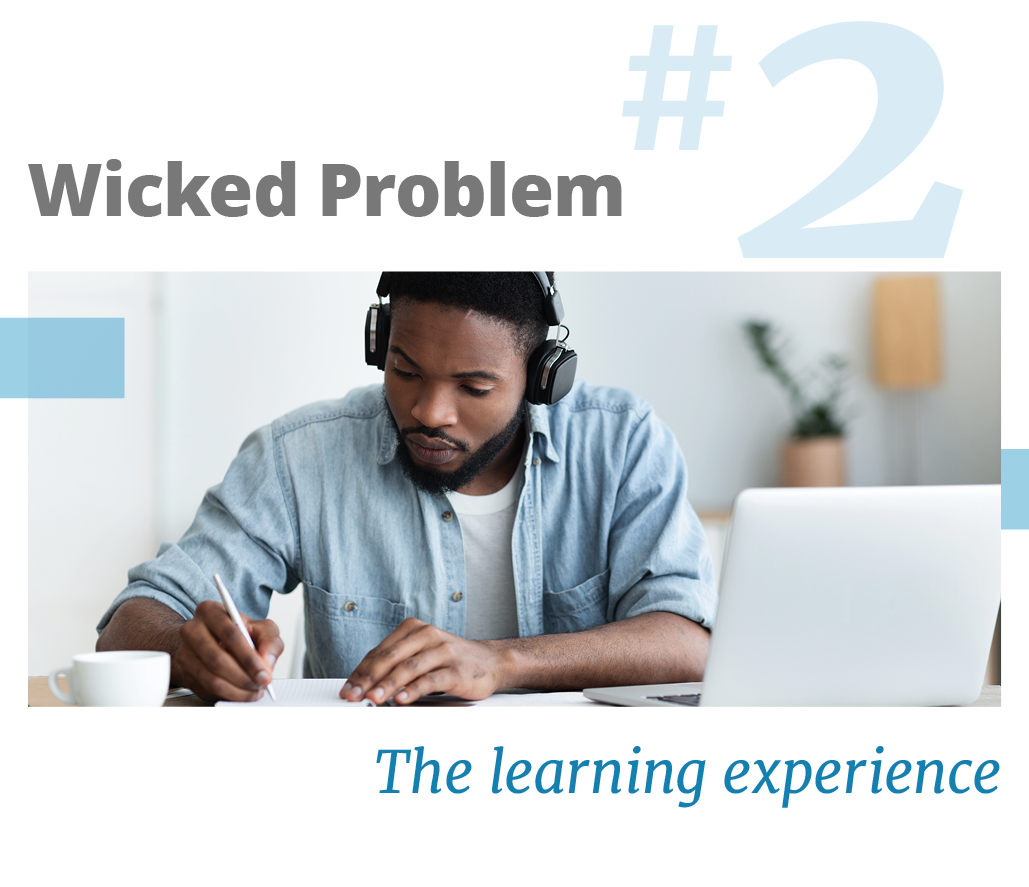
In this section, we explore last year’s predictions and our progress toward applying the best-known principles of learning within the broader experience. Within this broader topic, our work focuses on the following specific challenges:
- The design of curriculum, instruction, support systems, and organization do not reflect known principles of social psychology and its impact on learning
- Online learning models have not fully harnessed what is known about the science of learning
- Diversity of instruction and learning paths do not reflect the diversity of learners.
Last Year’s Prediction (1):
“AI applications in EdTech are going to get a lot messier before they get better. I anticipate raging debates about whether AI (and related technology) is worth it and if we're getting any real value from it. Eventually, things will settle and these tools will be institutionalized into education. But the extent to which these tools transform how we deliver instruction and support students — as opposed to simply retooling what education looks like today — is not a foregone conclusion and will not be resolved next year.” – Betheny Gross, Director of Research, WGU Labs
What we know now
This prediction was accurate in both the description of the current debate and the timeline for reenvisioning the learning experience through AI, which remains the focus of only a few major universities and initiatives rather than an accepted consensus. Students, on the other hand, appear to be embracing AI usage well beyond their institutions.
This year, we have observed an increasing sophistication among students in their utilization of AI and their understanding of where it can be applied most effectively. According to our research on working adult online learners, most students (91%) are aware of generative AI tools like ChatGPT, Gemini, and Claude, with 64% saying that they are confident in their ability to use AI tools effectively. Among students who have used AI in their academic studies, the most frequent uses are getting explanations of complex topics (47%), brainstorming creative ideas (40%), and receiving feedback on their work (39%).
For that same student population, 59% of students are optimistic about AI in education, and more than 60% are comfortable with AI using their data for personalized learning. Students have also responded positively to AI-enabled simulations that provide realistic opportunities to practice their skills or test their understanding, particularly when the experience allowed them to practice handling complex or conflict-filled situations in a safe environment. That said, students have also expressed frustration when AI proved too helpful, provided too many engagement activities, or generated inaccurate responses.
Our related work
Students are AI Optimists, but Women are at Risk of Being Left Behind
How College Students Use and View AI in the Learning Experience
5 strategies for designing student-centered AI experiences
2026 Prediction
“Rising skepticism about higher education’s value will collide with the rapid expansion of AI-enabled learning opportunities, setting the stage for a wave of disruption across the postsecondary sector in 2026. Students are already outpacing their instructors in using LLMs to accelerate learning, and soon Coursera’s full catalog will be accessible through ChatGPT. Major employers are expanding their own education pipelines, while a growing cohort of AI-powered providers are increasingly personalized alternatives to traditional degrees. If workforce Pell grants are fully implemented, they could channel significant public funding toward these new pathways. Together, these forces will push students and employers to reimagine what counts as a valid credential and to look well beyond the 2-year and 4-year degree models.” — Betheny Gross, Director of Research, WGU Labs
Last Year’s Prediction (2):
“As our CIN findings reveal, while AI and EdTech offer personalization and efficiency, they can also increase stress for faculty and students. The challenge for 2025 is navigating this tension, ensuring innovations enhance motivation and belonging without overwhelming users. Successful solutions will integrate the benefits of technology while safeguarding the well-being of those at the heart of education, striking a balance between advancing learning outcomes and supporting the human experience in increasingly complex learning environments.” – Omid Fotuhi, Former Director of Learning Innovation, WGU Labs
What we know now
As predicted, the rise in AI usage within the learning experience has created both opportunities for personalization and surfaced new concerns around mental health and well-being for faculty and students. In the past year, interest has grown in understanding the psychological effects of AI on learning, particularly as more institutions (including WGU Labs) have begun piloting AI-powered tools to proactively support students facing academic and emotional challenges.
Our research shows that while 81% of students are open to AI-enabled support, a majority still prioritize maintaining strong human connections. Notably, we found that 35% of students expressed a desire for more accessible, proactive, and tailored support, with students from historically underserved backgrounds being more receptive to AI interventions. Administrators are already responding to these shifts, with 83% of surveyed higher education professionals predicting that AI use cases for predictive models for student success will increase over the next two years
However, early findings suggest potential costs to well-being based on AI usage. According to a June MIT study, ChatGPT users drafting essays displayed the lowest brain activity and performed worse than their counterparts on various measures, which could ultimately decrease motivation and impact mental health. A University of Pittsburgh study found an increase in student anxiety, confusion, and distrust resulting from the utilization of AI in the classroom. For educators, many may be experiencing AI anxiety about potential reductions in human contact in teaching, autonomy, job insecurity, and the negative impact on both student learning and the long-term costs to institutions.
Our related work
Student Voices on Support: Experiences, Barriers, and the Future Role of AI
How first-time, first-term WGU students experience belonging at COIT
Beyond Counseling: Unlocking Student Belonging through Peer Connection
Understanding Belonging for Online Learners | Research Brief
Equity Audits: A Catalyst for Student-Centered Support Services
2026 Prediction
“In 2026, the push for ethically designed, emotionally aware tech will gain momentum. After years of erosion by social media and accelerated by AI, students and faculty will demand tools that foster authentic human connection, reduce isolation, and promote well-being, rather than just delivering efficiency. The next generation of technology will aim to rebuild what the last era of digital tools too often eroded. — Betheny Gross, Director of Research, WGU Labs
In this section, we examine last year’s predictions and our progress toward helping students connect more effectively to opportunities, both within and beyond the traditional learning experience. Our work within this area focuses on the following specific challenges:
- The transition from learning to work is opaque to students and employers and prone to leaks.
- Higher education is not structured to support continuous work/learn cycles that the modern workforce requires.
Last Year’s Prediction
"AI's next chapter in education isn't about flashy tools — it’s about building smarter, connected systems that make life easier for schools and students alike. By focusing on seamless integration and ethical innovation, EdTech can tackle the big, hidden challenges behind the scenes, paving the way for a future where education is more accessible, efficient, and impactful for everyone." – Former Steve Tedjamulia, Director of New Venture Programs, WGU Labs
What we know now
While the potential is clear, we have yet to see AI’s capabilities applied to create greater accessibility and attainment for traditionally underserved student populations, including working adult learners who now make up almost one-quarter of all undergraduate students.
According to our research, adult learners continue to face significant barriers to achieving their postsecondary learning goals, including life disruptions, feelings of isolation and anxiety, limited access to resources, and a disconnect between coursework and real-world applications. According to Digital Promise, combining AI and gamification in adult learning and digital literacy could increase attainment through personalization and increased engagement.
For those who do not persist, our research indicates that many non-degreed individuals are dissatisfied with their jobs, face barriers to obtaining ideal employment due to a lack of credentials, and struggle to translate their skills into other opportunities. Further, learner skepticism toward non-degree credentials persists, with only 33% believing employers value them. Individuals with disabilities, many of whom face similar employment barriers, could also benefit from AI-enabled systems that enhance accessibility and leverage data to connect them with high-quality career opportunities.
From an economic mobility perspective, industry leaders like JFF are creating guides to effectively identify opportunities for workforce upskilling and disruption based on new technologies. Our conversations with partners and our work to create a frontline manager certification this year affirm that AI could prove an effective tool for student career pathways through faster skills identification, personalized learning, and career navigation within company-specific talent pipelines.
Our related work
First-Mover Advantage: Capitalizing on the Growth of Vocational Rehabilitation Technology
When Life Gets in the Way: Understanding and Addressing Dropout Risks for Adult Learners
Bridging the Gap: What Non-Completers Say They Need From Higher Ed
The Missing Rung: Rebuilding Career Ladders in the Age of AI
Closing the frontline management skills gap with practical, real-world learning experiences
2026 Prediction
“In 2026, AI will accelerate disruption across higher education and workforce by exposing and challenging long-standing inefficiencies and entrenched processes. This new white space will enable the creation of comprehensive partner ecosystems to enact collaborative and systemic change that meets the needs of all learners, including those who have been previously excluded from the system entirely.” — Drew Ceccato, Lead, Strategic Partnerships and National Initiatives, WGU Labs
Conclusion
The challenges facing higher education today are not new, but the tools available to address them are. As we move into 2026, WGU Labs remains committed to designing AI-enabled solutions that increase access, personalize learning, and connect more students to real opportunity. The work ahead is complex, but with purposeful collaboration, human-centered design, and a relentless focus on impact, we believe we can help reimagine a system that works better for all learners.